Self-Paced Implementation
Build value architecture, structured selling, and deal qualification at your own pace. Built for founders, early-stage, growth-stage, and established companies that want to create the foundation themselves before adding more sales headcount or outside support.
Already enrolled? Log in to your materials
Who This Is For
The problem is that you are selling without a system. Every company has a different context. All of them share the same root cause: a sales motion that depends on individuals, intuition, or luck. The self-paced implementation gives you the architecture to change that.
You have early customers but no repeatable motion. Every deal is different. ICP is "anyone who will pay." Messaging is technical. Pipeline is your network. This implementation builds the foundation before you hire your first sales rep.
You raised because something worked. Now investors expect a scalable motion. Reps close differently. Qualification is inconsistent. CRM is noisy. Hiring a VP Sales will not fix this. A structured value architecture and sales process will.
You have a strong customer base and a proven product. But growth still depends on founder relationships and senior people who know how to sell. Sales 1.0 has a ceiling. This implementation gives you the structure to move beyond it.
You support cohorts of founders who know how to build but not how to sell. Mentors give conflicting advice. There is no standard. This self-paced implementation gives portfolio companies a repeatable GTM system they can work through at their own pace.
Founder & CEO
You want predictable revenue without being the one who closes every deal. This implementation gives you the language, process, and system to make that happen.
Revenue Leader
You have opinions about what good looks like, but the process and value architecture are not built out yet. This implementation gives you the structure to run a team, not just close deals yourself.
Product Leader
You know the product better than anyone, but sales keeps misrepresenting it and customers keep asking for things that are not on the roadmap. This implementation connects your capabilities to the language that wins deals.
Customer Story
"We finally had language that matched the sophistication of the product and a process that made our GTM repeatable beyond the founder."
GREYD is a Munich-based platform company behind Greyd.Suite, which enables agencies and enterprises to build and manage complex website ecosystems at scale. Despite strong product-market pull, their growth was constrained by founder-centric selling, technical messaging that did not connect to executive outcomes, and an unclear ICP across agencies, enterprises, and franchise organizations.
Using the ACT value architecture methodology, they defined 4 customer profiles, mapped 7 buying personas, articulated stakeholder-specific value, and built a repeatable sales motion. The results came fast.
Read the full case study6 weeks
Closed a flagship US franchise deal
One of the oldest and largest franchise organizations in the US. Closed with structured value messaging, clearer qualification, and stronger stakeholder alignment.
6 weeks
Full website rework across 4 ICPs
Reworked the entire site to guide each customer profile to persona-specific pages. Agencies forecasted 3 to 4 months. Delivered in 6 weeks.
24
ICP- and persona-specific demo videos
Generated to support every stage of the sales cycle, each grounded in the value architecture built during the engagement.
4 ICPs, 7 personas
Clear ICP-driven motion
Moved from "we sell to everyone" to a focused, repeatable motion with predictable qualification and forecasting.
22 steps across 4 sections
This playbook is distilled from how strong software companies build and run revenue organizations. It is adapted for founders and SMBs, based on 16 years in B2B GTM from early-stage startup to publicly traded company, and work as an angel investor in B2B companies. Learn more about me.
Concepts as foundation. Templates as the deliverable.
Each step starts with the concepts you need to understand: why something works, what it is designed to do, and where it fits in the process. Understanding is the starting point. The outcome is working material your team can use.
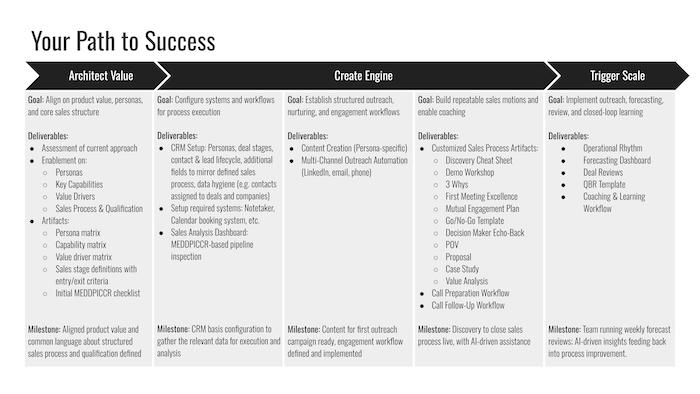
This introduction sets the stage for why technical founders hit a growth ceiling and how to think about sales the same way you think about product architecture. You will see what the implementation covers and how the sections build on each other.
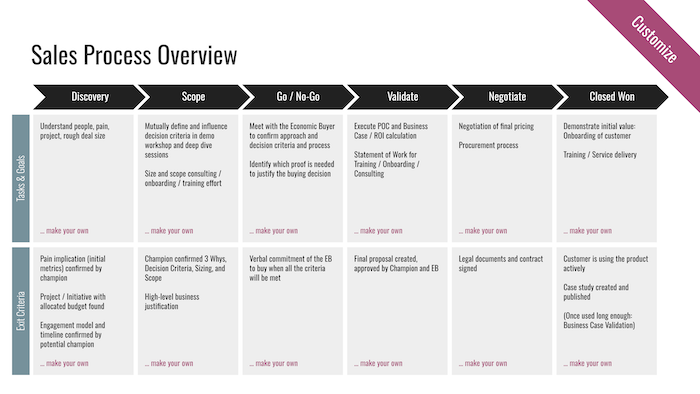
This step lays the foundation for everything that follows: a structured, repeatable sales process. It introduces the buyer journey and maps it to the activities that move a prospect through each stage of the sales cycle.
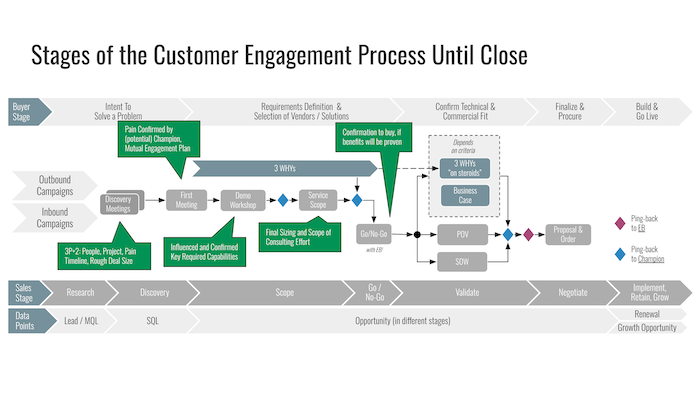
You will learn how to select the right sales motion based on your ACV and deal complexity, whether that is a high-velocity self-serve approach or a more guided, human-led process. The step gives you a practical development kit to design a sales process that fits your business.
This step introduces MEDDPICCR and shows you how to use it as a GPS alongside your sales process. You will walk through each dimension and learn how to identify what is missing in any deal before it costs you time.
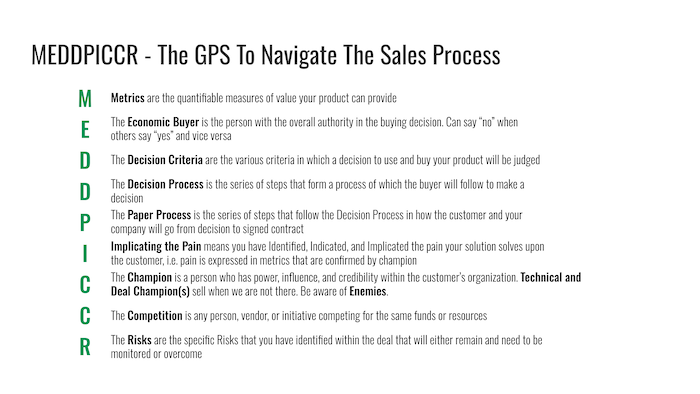
You will learn how to implement all nine MEDDPICCR dimensions directly in your CRM and use AI automation to keep records updated after every call. This is the tooling layer that makes the framework stick across your whole team.
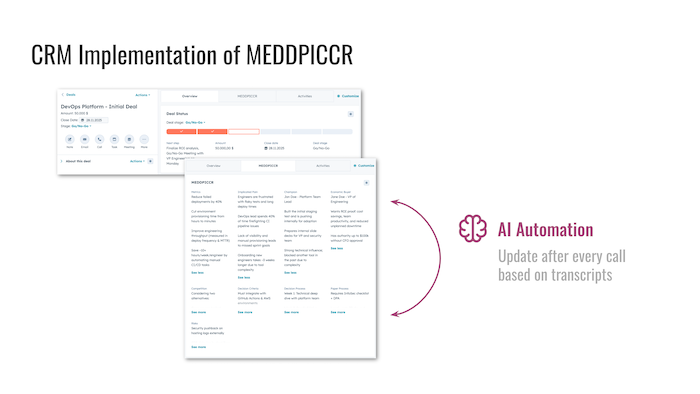
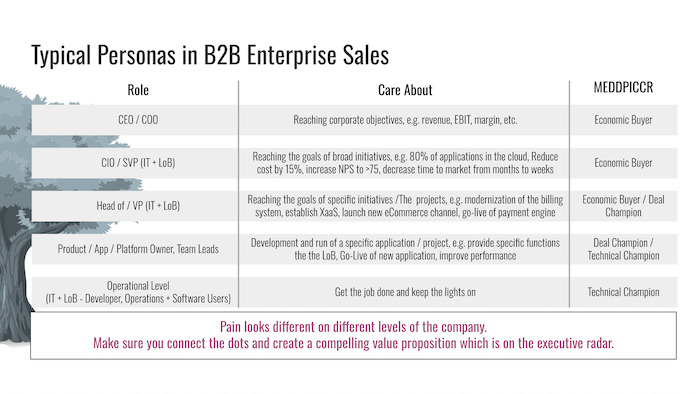
This step builds the foundation of your value architecture by defining exactly who you are selling to and what they actually care about. Without this clarity, everything downstream is guesswork; with it, every conversation becomes more focused and more effective.
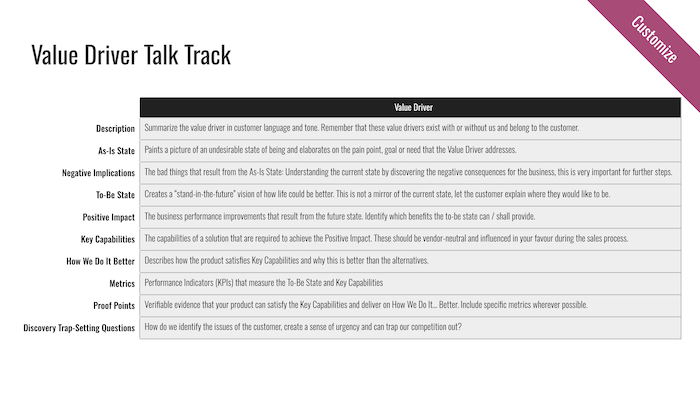
Value Drivers are the top-level business problems your product solves. This step challenges the instinct to lead with what the product does and instead focuses on what problems it eliminates, teaching you to speak the language your buyers use: regulation, competitive edge, cost, revenue, and risk.
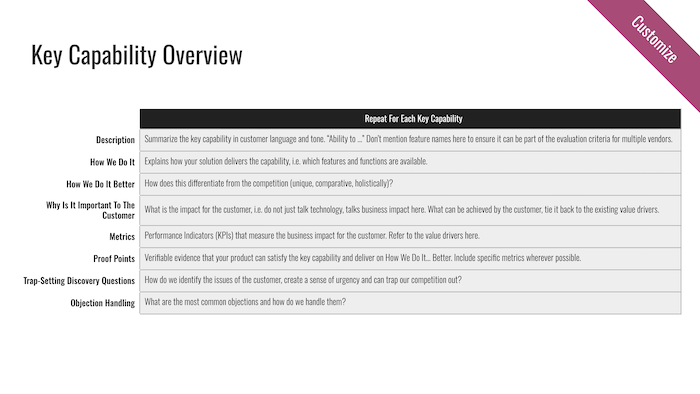
This step goes one level deeper into the specific capabilities your product must demonstrate to deliver on your value drivers. You will learn how to use them strategically to shape evaluations, influence the customer requirements, and position yourself to win.
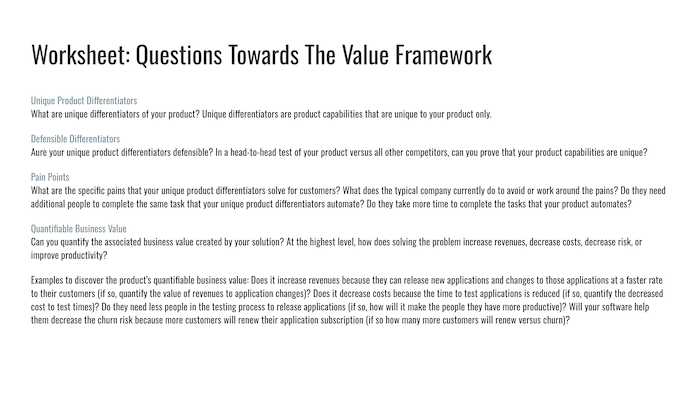
Through a guided set of questions, you will work through your unique product differentiators, defensible competitive advantages, and the specific pain points they address. It is designed to be used as a working session, either solo or with your team, to ground your value framework in real product strengths.
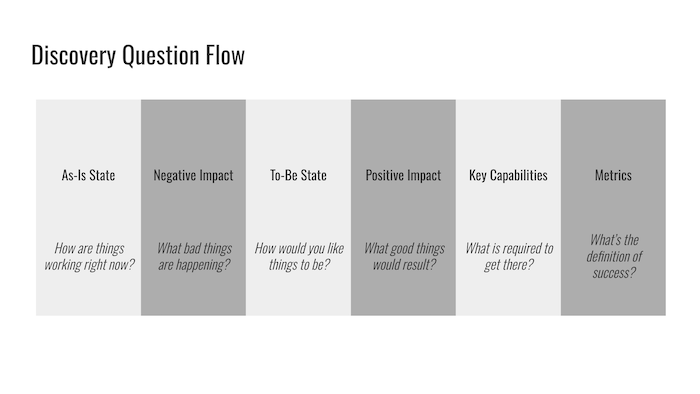
Discovery questions are two-sided tools: they help you uncover customer needs and pain while creating a sense of urgency and mapping your product to their problems. You will leave with a clear method for turning every conversation into a useful source of deal intelligence.
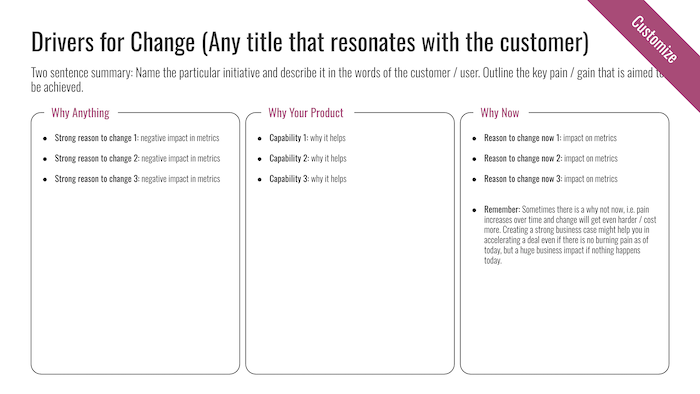
The 3 Whys framework equips your champion to walk into the room with the economic buyer and articulate why they need to act, why your product is the right one, and why now. If your champion cannot answer these three questions clearly and credibly, the deal will stall.
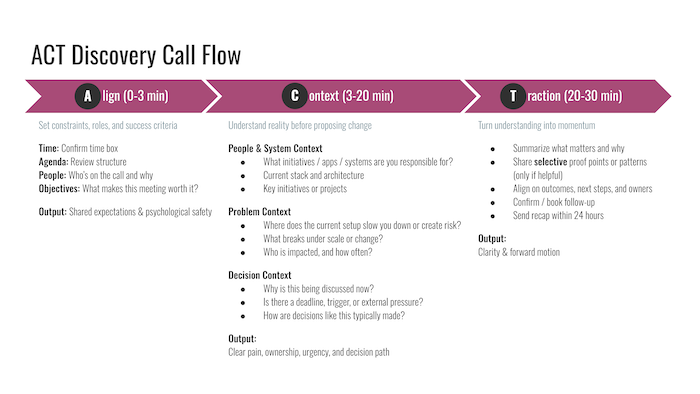
This step shows you how to prepare for, run, and debrief a discovery call with precision: what you need to walk away with and how to avoid the most common mistakes technical founders make. Weak discovery is almost always the root cause of deals that stall or fall apart later.
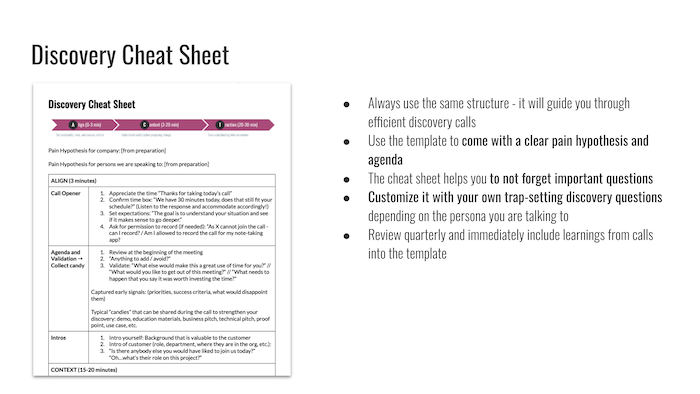
The Discovery Cheat Sheet is a practical template that helps you show up prepared, ask the right questions in the right order, and capture exactly what you need without relying on memory or improvisation. It is designed to be used consistently across all deals, so discovery becomes a process, not a performance.
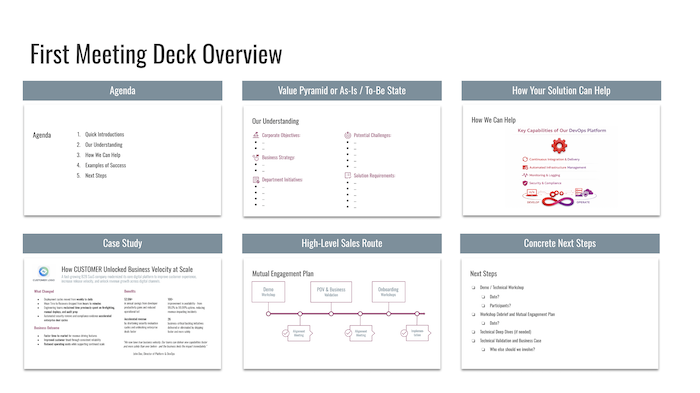
This step covers when you are ready for a First Meeting, how to run it effectively, and what needs to happen afterward. Done well, the First Meeting is what turns a prospect into an engaged buyer.
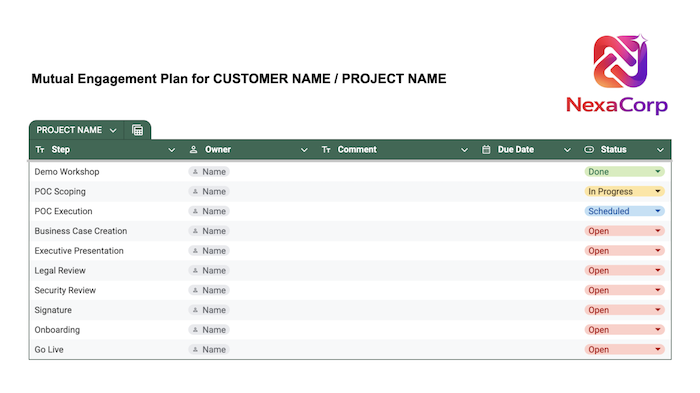
Create a sense of urgency without being pushy: The Mutual Engagement Plan (MEP) keeps deals moving from the First Meeting all the way to signature without losing control of the process along the way. It is the tool that turns the sales process into something you and the customer work through together.
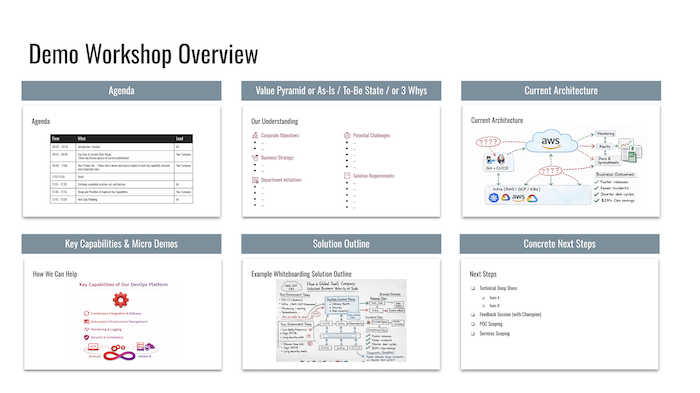
This step shows you how to run a demo that does more than impress: it locks in the key capabilities that matter to the evaluation, builds consensus across stakeholders, and sets up everything that follows. A well-run Demo Workshop is the foundation for the proof-of-concept, the business case, and ultimately the close.
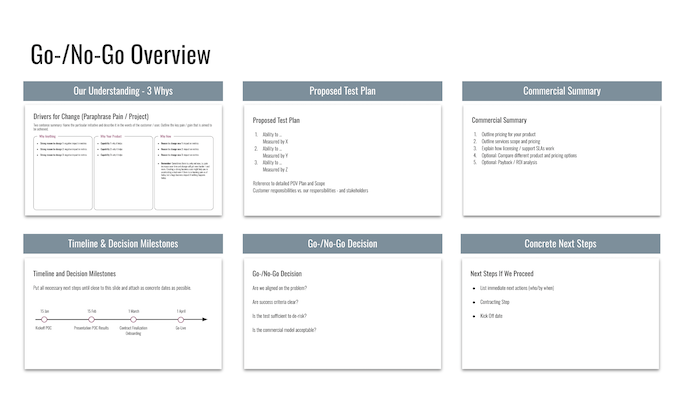
Before committing significant resources to a technical evaluation, you need a clear go-ahead from the economic buyer. This step covers exactly that: the gatekeeping moment that protects your time and the customer's time, and a step many sales processes skip entirely.
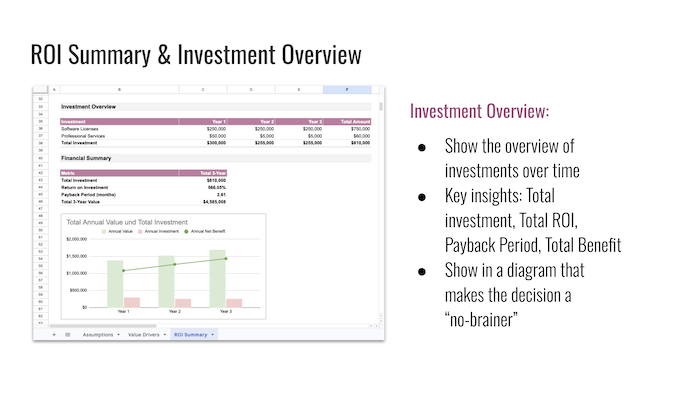
A business case is not a pricing slide. It is the financial argument for why the cost of change is lower than the cost of staying put, and this step shows you how to build one that is credible, quantified, and compelling enough for an executive to act on, all grounded in your value architecture.
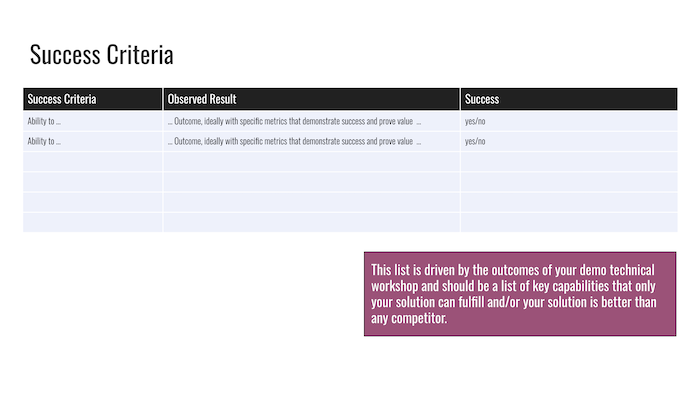
This step shows you how to scope, structure, and run a proof-of-concept that stays focused and moves toward a signed deal, including how to define success criteria upfront and keep the evaluation on track. You will learn how to position the results to accelerate the close rather than restart the conversation.
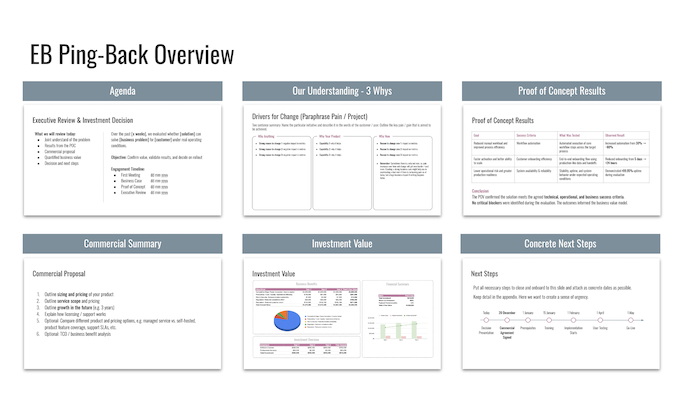
The Economic Buyer Ping-Back is the executive review you run after the business case and proof-of-concept are complete. You present the evaluation results, confirm the commercial structure, and move to a formal proposal. This step helps you run that meeting with the confidence and clarity that earns a yes.
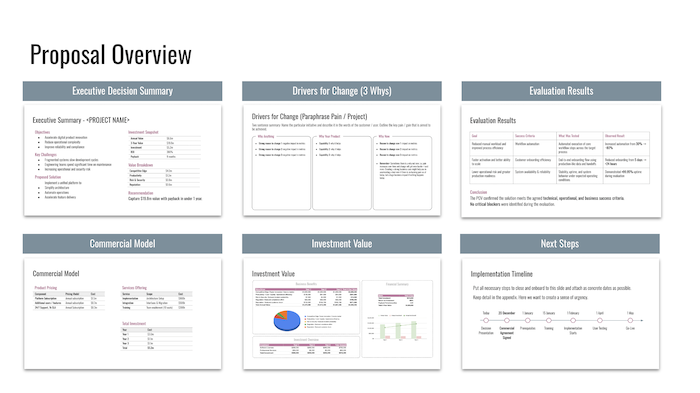
The formal proposal captures everything agreed upon through the sales process and plays a specific role at the close. A strong proposal should feel like a natural conclusion to the process, not a surprise.
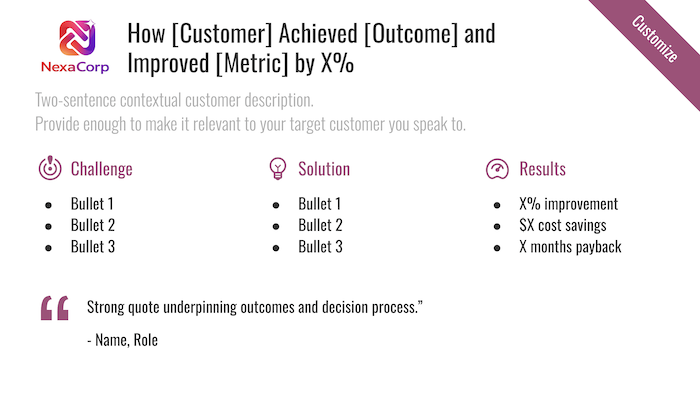
This step shows you how to build case studies that work across multiple formats: from one-pagers to slide decks to verbal references, so that one solid story can be deployed throughout the deal cycle. Done right, case studies transform your satisfied customers into advocates who help you win the next deal.
495 EUR
Total price. One-time payment.
Includes 12 months of platform access and updates.
Tax included where applicable.
Already enrolled? Log in to your materials
What's included
Get access to the full self-paced implementation and start building your value architecture today.
 ACT Playbook